
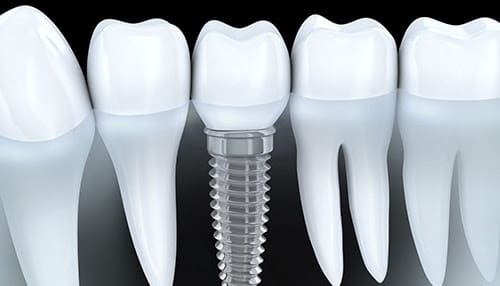
Dental implants are small posts, usually made of titanium or zirconia, surgically fastened to your jawbone below the gums, onto which artificial teeth can be mounted. These implants actually become anchored to your bone through osseointegration (the bone fuses to the implant). This process provides stable support you can rely on while eating and speaking.
Adapted from content medically reviewed by Colgate Global Scientific Communications – colgate.com
The Parts of a Dental Implant
An implant restoration has three main parts:
- The implant: a small post, usually made of titanium or zirconia, placed in the jawbone where the tooth root used to be.
- The abutment: a connector attached to the top of the implant. It rises just above the gumline and holds the replacement tooth.
- The crown (or other restoration): the visible, tooth-shaped part, custom-made to match the color and shape of your nearby teeth.
Because the implant is anchored in bone like a natural root, the replacement tooth stands on its own and doesn’t rely on the neighboring teeth for support.
Replacing a Single Tooth
When one tooth is missing, a single implant topped with a crown can replace it. The teeth on either side are left untouched, unlike a traditional bridge, which requires reshaping those teeth for crowns.
Replacing Several Teeth
When several teeth in a row are missing, an implant-supported bridge may be used: two or more implants hold a bridge that spans the gap, so each missing tooth doesn’t need its own implant. Implants can also support and stabilize dentures, helping them stay in place while you eat and speak. Your dentist will talk with you about which approach suits the number and location of your missing teeth.
How the Implant Process Works
Implant treatment happens in stages. Every case is a little different, but the main steps are:
1. Consultation and Imaging
Your dentist examines your mouth, reviews your medical history and takes X-rays. We use a 3D cone beam scan to see how much bone is available, where nearby nerves and sinuses are, and to plan the size, position and angle of each implant. See our technology for more about this scan.
2. Preparing the Site
If a damaged tooth is still in place, it is removed first. Sometimes the jawbone is too thin or too short to hold an implant; in that case, a bone graft may be needed to rebuild the area before the implant is placed. When it is, bone grafting can be done here in our office.
3. Placing the Implant
With the area numbed, the implant is placed into the jawbone through a small opening in the gum. Depending on the case, the gum is closed over the implant, or a small healing cap is left showing through the gum. In some cases, a temporary replacement tooth can be worn in the meantime.
4. Osseointegration
Over the following months, the bone grows around and bonds to the surface of the implant. This process, called osseointegration, is what makes an implant strong and stable. Your dentist confirms that the implant is firmly fused before moving to the next step.
5. Abutment and Final Restoration
Once the implant is stable, the abutment is attached and a digital scan of your teeth is taken. A crown, bridge or denture is then custom-made to fit, matched to your natural teeth, and secured to the abutment with a small screw or with dental cement.
Caring for Dental Implants
Implant crowns can’t get cavities, but the gums and bone around an implant can still become inflamed if plaque builds up, a condition called peri-implantitis. Brush twice a day, clean around the implant daily with floss or small interdental brushes, and keep up with regular checkups and cleanings so your dentist can check the implant and the tissue around it. If you’re considering implants in Redmond, we’ll be glad to answer your questions at a consultation.
Implant Videos


Ready to schedule a visit?
Send us an appointment request and we will contact you within one business day, or call us at (425) 867-1484.